

At Fusion IT, we understand the need to use new tools and technologies that bring value to the daily work of all teams.
In a context where trust, quality, and development speed are key, traditional test automation has received a radical upgrade with the arrival of artificial intelligence.
Today, we want to share knowledge about a tool we use: Playwright combined with MCP (Model Context Protocol). This is an architecture that allows us to automate not only test execution, but also the generation, validation, and evolution of test suites by leveraging artificial intelligence.
What is MCP and why does it matter to us?
MCP is an open protocol that allows AI models to connect directly with tools such as browsers, databases, APIs, code repositories, and pipelines.
This enables possibilities and scenarios that previously required much more time and effort from test automation engineers:
- Analyze source code
- Detect changes between versions
- Navigate an application using a preconfigured Playwright setup
- Automatically generate or adjust test suites
- Execute test suites
- Validate results
- Generate impact and risk reports aligned with enterprise standards
Why is Playwright the ideal foundation?
At Fusion IT, one of the tools we use as our E2E engine is Playwright because it allows for more accurate, modern, and reliable automation. It provides built in drivers for the most common browsers, robust selectors, native auto-waiting, fast and parallel execution, CI/CD integration capabilities, and excellent support for modern architectures such as microfrontends and SPAs.
How do we use MCP + Playwright in real scenarios, and what is its real power?
At Fusion IT, we generate test automations using MCP, which can navigate the application, analyze HTML structure and behavior, detect forms, critical flows, and user actions. In addition, the person creating the test suite provides business rules to follow, user story conditions with clearly defined acceptance criteria, and context by providing code from a specific branch, among other inputs. This creates the appropriate environment for MCP to work as the test automation engineer needs, generating tests that are 100% aligned with business requirements, without ambiguity between different roles (BA, Dev, QA), and automatically providing evidence of compliance.
End-to-end validations are performed not only at the UI level; it is also possible to connect database validations, internal APIs, and external services within the same test suite.
This MCP has the capability to generate sub-MCPs that help manage interactions with other resources, such as a sub-MCP responsible for executing database queries to retrieve users who meet or do not meet acceptance criteria, allowing the creation of specific tests based on that data.
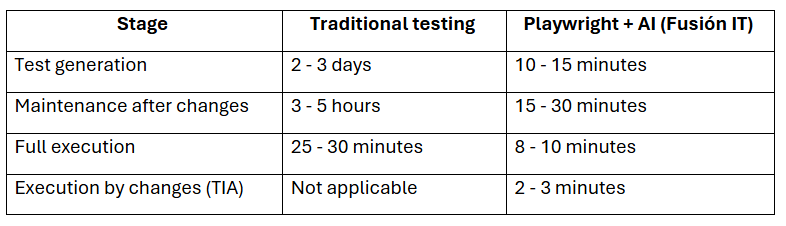
Another scenario where we have introduced improvements is test impact analysis (TIA). MCP has been integrated to mitigate the bottleneck commonly generated when executing a full test suite with a large number of tests. In this case, MCP is able to analyze which files have changed, which components were affected in a new deployment, which business flows depend on those changes, and execute only the relevant tests.
Scenario: medium-sized web application
Test count: 100 E2E tests
Standard CI/CD pipeline
Total time reduction: up to 80 – 90%
The future of testing
Modern QA professionals need to learn how to master these types of tools, as they improve their ability to make better decisions about what to validate, how, when, and why.
The combination of MCP + Playwright allows us to move:
- From manual to intelligent
- From reactive to predictive
- From costly to strategic
At Fusion IT, we are on the path of strengthening ourselves with AI-powered tools, where technology adapts to the product, not the other way around.